0W-16 vs 0W-20 Motor Oil
If you’ve ever looked at your car’s manual to find the right oil, you probably saw those confusing numbers like 0W-16 or 0W-20. Don’t worry—you’re not alone. Many drivers feel lost when they see these labels. The good news is that once you understand what those numbers mean, picking the right engine oil becomes super simple.
Let’s talk about what makes these two oils different and help you figure out which one your car really needs.
What Do Those Numbers Actually Mean?
Before we dive into the comparison, let’s decode this mystery. The numbers in motor oil grades tell you something important about how the oil behaves at different temperatures.
Take 0W-20 for example. That first number—the 0—tells you how the oil flows in cold weather. The lower this number, the thinner the oil is when it’s cold. The “W” stands for winter. The second number—20 in this case—tells you how thick the oil is at normal operating temperatures.
So 0W-20 means your oil flows like a 0-weight oil when it’s freezing outside, but acts like a 20-weight oil when your engine heats up.
The same logic applies to 0W-16. It flows like a 0-weight oil in cold weather and acts like a 16-weight oil when warm.
Think of it like this: thinner oil pours easily when cold, thick oil doesn’t budge. Your engine needs oil that flows quickly when you start it on a frosty morning, but stays thick enough to protect moving parts when the engine is hot.
The Main Differences Between 0W-16 and 0W-20
Thickness at Operating Temperature
The biggest difference between these two oils is what happens when your engine reaches normal running temperature.
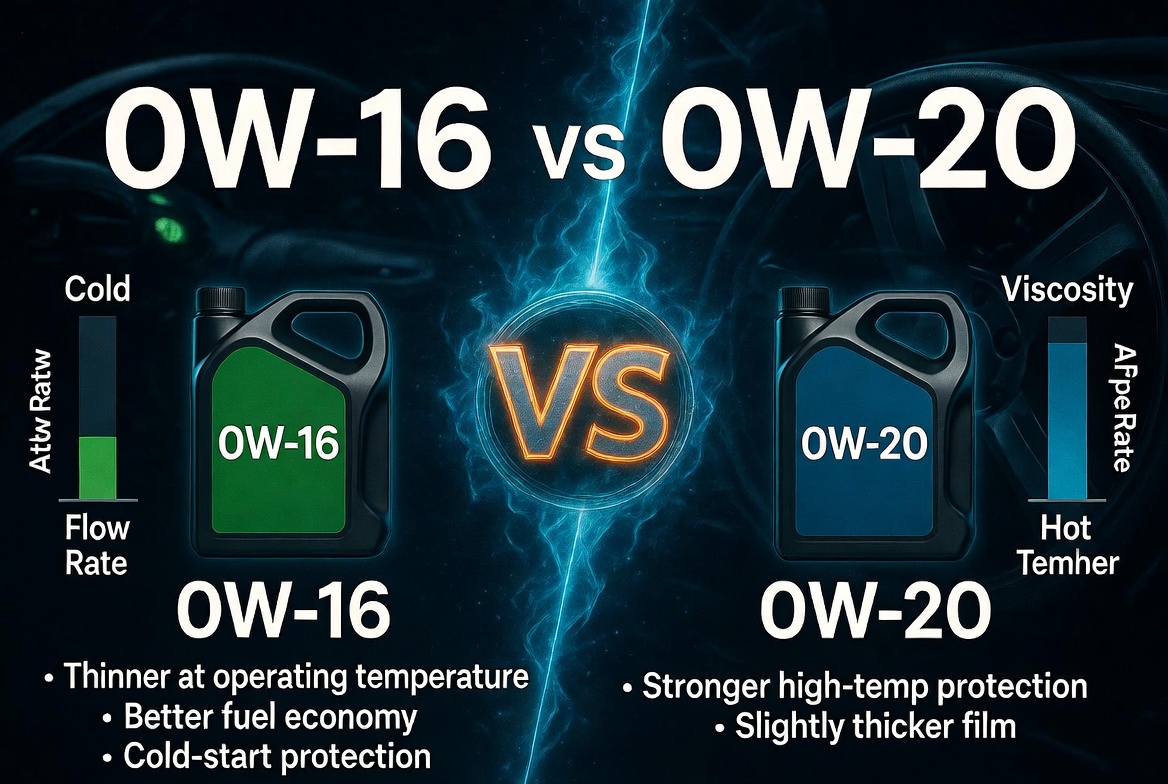
0W-20 is thicker at operating temperature. It provides more protection through a thicker film between engine parts. This thicker layer can handle more pressure and friction.
0W-16 is thinner at operating temperature. It flows more easily through the engine, creating less resistance. This means less friction, which can help your engine run more smoothly.
Cold Weather Performance
Both oils start equally thin in cold weather. The 0W in both names means they have the same cold-weather viscosity. On a freezing morning, neither oil will cause you problems. Your engine will turn over easily with either one.
This is really important: cold-start performance is identical between these two oils.
Fuel Economy Impact
Here’s where 0W-16 shines. Because it’s thinner at operating temperature, it creates less drag inside your engine. Less drag means your engine doesn’t have to work as hard. Less work means better fuel efficiency.
If fuel economy matters to you, 0W-16 might help you go a bit further on each tank of gas.
0W-20 is slightly thicker, so it creates a bit more resistance. This means slightly lower fuel economy. But we’re talking about small differences here—maybe one or two percent improvement with 0W-16.
Engine Protection
0W-20 offers more protection because of its thickness. The thicker oil film between parts protects better against wear and tear. If your engine runs hot or you drive aggressively, the extra thickness matters.
0W-16 still protects your engine well. It’s not like thin oil will trash your engine. The thinner film just means slightly less cushioning between moving parts. For normal driving, this difference is minimal.
Which One Does Your Car Need?
Here’s the golden rule: use what your manufacturer recommends. Your car’s manual has the answer. That’s the first place you should look.
Manufacturers spend millions testing different oils in their engines. They know exactly what viscosity their engines need. They recommend a specific oil grade because that’s what works best for that particular engine design.
Don’t guess. Don’t ask your friend. Don’t go by what someone online says. Check your manual.
Why Manufacturers Care About Viscosity
Car makers are very particular about oil viscosity. Too thick, and your engine works harder. You lose fuel economy and put extra strain on the engine. Too thin, and protection suffers. Parts wear faster.
The viscosity recommendation balances protection and efficiency perfectly for that engine. That’s why it matters.
Can You Switch Between Them?
This is where things get tricky. If your car requires 0W-20, you shouldn’t just use 0W-16 because it’s cheaper or you found it on sale.
Some newer cars are designed specifically for 0W-16. If your manual says 0W-16, use 0W-16. These engines have tighter tolerances and depend on that specific viscosity.
On the other hand, some older car models only specified 0W-20. Using 0W-16 in those engines might affect how well the oil protects your engine.
The takeaway? Stick with what your manual says. This is not the place to experiment.
Why Are Engines Designed for Different Oils?
Newer cars are usually designed for thinner oils like 0W-16. Here’s why: emissions standards. Governments keep tightening emissions rules every year. To meet these rules, manufacturers design engines that are more efficient.
Thinner oil reduces internal friction, which helps engines be more efficient. More efficient engines produce fewer emissions and use less fuel.
Older cars were designed with different standards in mind. They often use thicker oils like 0W-20 because those engines have different internal designs.
As technology advances, you’ll see more cars moving toward thinner oils. But each generation of engines is different.
Synthetic vs Conventional: Does It Matter?
Let’s add another layer to this conversation. Both 0W-16 and 0W-20 come in synthetic and conventional versions.
Synthetic oil is made in a lab. It’s produced from chemicals that are carefully designed and controlled. This gives synthetic oil several advantages.
Conventional oil comes from crude oil pulled from the ground. It’s refined to remove impurities and create an oil that works in engines.
Synthetic oil lasts longer. You can often go 7,500 to 10,000 miles before needing a change. Conventional oil usually needs changing every 3,000 to 5,000 miles.
Synthetic oil flows better at extremely cold temperatures. On the coldest winter mornings, synthetic starts more easily.
Synthetic oil costs more upfront. But because you change it less often, the total cost can be similar to conventional oil over time.
The viscosity grade—whether it’s 0W-16 or 0W-20—matters regardless of whether you choose synthetic or conventional. Your manufacturer recommendation applies to either type.
What About Performance Driving?
If you push your car hard at the track or enjoy spirited driving, does this affect which oil you should use?
The answer is still the same: follow your manufacturer’s recommendation. They’ve designed engines for specific oils.
However, some drivers who track their cars might choose synthetic oils because they handle extreme heat better. But the viscosity grade remains what it should be.
Your car’s manual was written with normal driving in mind. If you do something different—like track racing—you might want to talk to a mechanic who specializes in performance driving. They can advise if anything changes.
For the vast majority of drivers, the simple rule applies: use what the manual says.
Reading Your Manual
Let’s make this practical. Here’s how to find the right oil information in your manual:
Open your manual. Look for the maintenance section or specifications section. You’ll find something called “recommended engine oil” or “engine oil specifications.”
The manual will probably list one viscosity grade. It might also list acceptable alternatives, but there’s usually a primary recommendation.
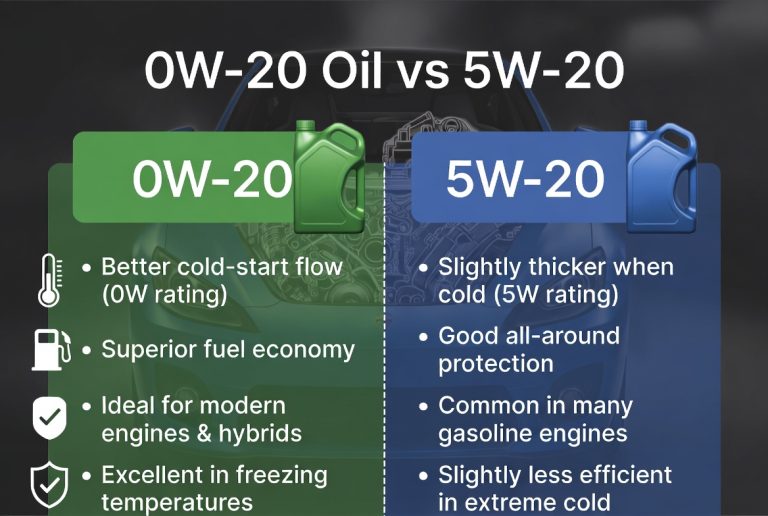
Some manuals might say something like “0W-20 (preferred)” or “0W-20 or 5W-20 acceptable.” In this case, 0W-20 is your best choice.
Write down what it says. That’s what you’re looking for at the auto parts store.
Cost Differences
0W-16 might cost slightly more than 0W-20. Newer products sometimes cost a bit more because fewer cars use them. But the difference is usually just a dollar or two per quart.
Don’t let price be the deciding factor. Buy what your car needs.
However, here’s where costs might matter: if your car uses 0W-16 and it’s more expensive in your area, you might save a few dollars with synthetic oil since you change it less often.
Let’s say 0W-16 synthetic costs $8 per quart but you only change it every 10,000 miles. 0W-20 conventional costs $5 per quart but needs changing every 3,000 miles. The math might work out similar over time.
Do the math for your specific situation. Check local prices and see what makes sense for your wallet.
Availability: Can You Find It?
Here’s a practical concern: can you actually find 0W-16 easily?
0W-20 is everywhere. Every auto parts store stocks it. Gas stations sell it. You can get it at supermarkets. Finding 0W-20 takes no effort.
0W-16 is less common. It’s used in many newer Honda, Toyota, and Mazda models, but not every store carries every brand. You might need to order it online or go to a specific parts store.
This might not seem important, but imagine you’re on a road trip and need oil. With 0W-20, you can stop at any station. With 0W-16, you might have fewer options.
If you drive a car that requires 0W-16, consider:
- Keeping a bottle or two at home
- Finding a reliable source for ordering
- Checking availability before a long trip
The Bottom Line
Both 0W-16 and 0W-20 are excellent modern motor oils. They serve different purposes for different engines.
0W-16 works best for newer cars designed for maximum efficiency. It provides better fuel economy because of lower viscosity. It still provides plenty of engine protection for normal driving.
0W-20 works great for a wide range of vehicles. It offers slightly thicker protection while still maintaining excellent cold-weather performance. It’s more widely available and costs about the same.
The real answer? Check your manual. Your manufacturer spent time and money figuring out which oil your engine needs. That recommendation is based on real engineering, not guessing.
Common Questions About Oil Viscosity
Can I mix 0W-16 and 0W-20?
Technically yes, you can pour them together. They’re both 0W oils and will mix. But you shouldn’t do this. You’ll end up with something between 0W-16 and 0W-20, which doesn’t match what your engine needs.
Only use what your manual specifies.
What happens if I use the wrong viscosity?
For one oil change, nothing catastrophic will happen. But if you consistently use the wrong oil, problems develop over time.
Too thick and your engine strains. Fuel economy drops. Cold starts become harder.
Too thin and protection suffers. Parts wear faster. In extreme cases, engine damage happens.
Does the brand matter?
Not as much as the viscosity. All major oil brands meet industry standards. Whether you choose Mobil, Castrol, Shell, or store brands, what matters most is the viscosity number.
That said, sticking with recognized brands from established manufacturers is smart. They invest in quality.
Should I change to 0W-16 for better fuel economy?
Only if your manual says it’s okay. If your car specifies 0W-20, using 0W-16 is wrong. Never sacrifice following manufacturer specs for minor fuel economy gains.
Most people don’t switch oils between different cars they own. You use what each individual car requires.
How often should I check my oil?
Check it at least monthly. Do it when your engine is cold, on level ground, before you drive.
You’ll need an oil dipstick. Pull it out, wipe it clean, put it back in, then pull it out again. The oil level should be between the minimum and maximum marks on the stick.
Some newer cars don’t have dipsticks. Check your manual for the procedure.
Signs Your Engine Oil Needs Attention
Watch for these warning signs:
Your check engine light comes on. This might be an oil pressure problem.
You hear engine knocking. This can mean insufficient oil protection.
You smell burning oil. This suggests oil overheating or leaking.
Your oil looks dark and dirty. This means it’s time for a change.
You notice engine sludge. Thick, dark stuff in your oil means you’ve gone too long between changes.
If you notice any of these problems, get your oil checked immediately.
The Importance of Regular Oil Changes
No matter whether you use 0W-16 or 0W-20, regular oil changes are essential.
Oil breaks down over time. It gets dirty. It loses its protective qualities. Engine wear increases. Your engine works harder and less efficiently.
Follow your manual’s maintenance schedule. Most modern cars go 5,000 to 10,000 miles between changes, depending on conditions and oil type.
If you do a lot of short trips or drive in stop-and-go traffic, you might need changes more frequently.
Keep records of your oil changes. This helps track maintenance and proves to future owners that the car was properly maintained.
Making the Right Choice
Here’s your action plan:
First, locate your owner’s manual. Look for the engine oil specification.
Write down the exact viscosity grade your manual recommends.
Check your local auto parts stores for availability.
Buy quality oil that matches the specifications. Synthetic or conventional—both work. Just match the viscosity grade.
Keep a spare bottle at home if it’s hard to find locally.
Change your oil on schedule. Set a calendar reminder so you don’t forget.
Remember: your manufacturer knows your engine better than anyone. Trust their engineering. Use what they recommend.
The difference between 0W-16 and 0W-20 is real, but it’s not complicated. It simply comes down to viscosity at operating temperature. Both are excellent oils in modern engines. Just use the right one for your specific car.
Understanding Engine Protection in Detail
Let’s dig deeper into how engine protection works with different oil viscosities. This will help you truly understand why manufacturers make these choices.
Inside your engine, metal parts move against each other constantly. Pistons slide up and down. Crankshafts spin. Valves open and close. All these parts rubbing together create friction and heat.
Oil creates a protective film between these parts. This film prevents direct metal-to-metal contact. The film separates the surfaces, allowing them to slide smoothly.
A thicker oil creates a thicker film. A thinner oil creates a thinner film. Both can work, as long as the film is thick enough.
0W-20 creates a thicker film at operating temperature. This thicker layer can handle more extreme conditions. If your engine gets really hot, or if you drive hard, or if something goes wrong temporarily, that thicker film provides more cushion.
0W-16 creates a thinner film, but it’s still plenty thick at operating temperature to protect your engine. For normal driving, the thinner film works perfectly fine.
Think of it like a mattress. A thick mattress provides more cushioning. A medium mattress still supports you fine. Both work—just differently.
Modern engines are precise machines. They’re engineered to run on specific oil viscosities. A newer engine designed for 0W-16 has tighter tolerances than an older engine. That tighter design allows for thinner oil.
An older engine with looser tolerances needs thicker oil to maintain protection.
How Engine Design Has Changed
Engine technology has evolved dramatically. Newer engines look completely different from engines made decades ago.
Older engines were heavy, simple, and loose. They had more space between moving parts. They needed thicker oil for protection. They also ran hotter and used more fuel.
Modern engines are lightweight, precise, and computerized. They have tight tolerances because they’re manufactured with extreme accuracy. They run cooler and more efficiently.
This tighter design allows thinner oil. In fact, thinner oil is better in modern engines because it reduces friction and improves efficiency.
As a result, newer cars from Toyota, Honda, BMW, and others shifted to 0W-16 and similar low-viscosity oils. These engines were engineered specifically for these thinner oils.
If you own a newer car and find that it needs 0W-16, you’re experiencing this engineering evolution firsthand.
Real-World Driving Conditions
How you actually drive your car matters, but not in the way you might think.
Cold starts matter for oil viscosity selection. Both 0W-16 and 0W-20 start easily in cold weather. That’s what the 0W part guarantees. You won’t have cold-start problems with either oil in winter.
Highway driving is easy on oil. You’re cruising at steady speed. The engine temperature stays consistent. Oil circulates smoothly. Both oils work great for highway driving.
Stop-and-go city driving is harder on oil. Your engine temperature fluctuates. You accelerate and decelerate constantly. Oil heats up, cools down, heats up again. The oil works harder in city driving.
Even in stop-and-go conditions, modern oil works well. 0W-20 provides a safety margin with its thicker protection. 0W-16 still handles it fine because engines are designed for it.
Towing is one area where oil thickness matters more. If you tow a trailer or boat, your engine gets hot. It works harder. It needs better protection.
If you tow regularly, you might want to check if your manual offers any guidance. Some manuals recommend checking the transmission fluid or changing service intervals when towing. Sometimes they don’t mention oil changes. Follow what your manual says.
Track driving is extreme. Your engine reaches maximum temperature. It operates under maximum stress. This is where the thickest protection possible becomes important.
If you’re serious about track driving, consult a performance specialist. They can advise if your manufacturer’s recommendations still apply or if adjustments make sense.
For the 99% of drivers who do normal driving, your manual’s oil recommendation works perfectly.
When Warranty Issues Matter
Here’s something important: car warranties depend on proper maintenance. Proper maintenance includes using the right oil.
If you use the wrong oil and your engine fails, the manufacturer might not honor your warranty claim.
Let’s say your car requires 0W-16. You use 0W-20 instead because you think the extra thickness helps. Then your engine has a problem.
The manufacturer checks your service records. They see you used the wrong oil. They deny the warranty claim.
Now you’re responsible for expensive repairs that the warranty would have covered.
This isn’t just about following rules. It’s about protecting your investment.
Every time you change your oil, keep a receipt. Write down the date, mileage, and exactly what oil you used. These records prove you maintained your car correctly.
Storage and Oil Quality
Once you buy oil, how you store it matters.
Store oil in a cool, dry place. Don’t leave it in direct sunlight. Heat breaks down oil even when it’s not in your engine.
Don’t store oil in an unheated garage through winter if you live somewhere very cold. Extreme cold can affect oil properties.
An air-conditioned indoor storage area is ideal. Or a basement. Or any cool, dry space.
Properly stored oil stays good for a long time. You don’t need to worry about an oil bottle expiring.
Mixing Brands and Types
You might worry: can you use different oil brands from change to change?
Absolutely. You can use Shell one time and Mobil the next time. No problem.
What matters is the viscosity and that the oil meets industry standards.
All major brands produce oils that meet or exceed industry specifications. You can mix and match brands without issues.
However, you should stick with the same type. If you use synthetic oil, keep using synthetic oil. If you use conventional oil, stick with conventional.
Mixing synthetic and conventional in the same engine is okay in the short term. But for consistency, stay with one type.
The Future of Oil Viscosity
The trend is toward thinner oils. As engines become more efficient and emissions standards get tighter, manufacturers will likely recommend thinner oils.
You might see 0W-12 become more common. You might see even thinner oils in the future.
The good news is the selection and availability will improve. As more cars use 0W-16, stores will stock more of it.
Your job remains the same: check your manual and use what it recommends.
Maintenance Beyond Oil Selection
Oil is just one part of engine maintenance. Here’s what else matters:
Oil filters need changing with every oil change. The filter catches dirt and debris. A dirty filter reduces oil flow.
Air filters need changing too. A dirty air filter makes your engine work harder.
Coolant needs maintenance. It keeps your engine at the right temperature. Without proper coolant, heat damages your engine.
Spark plugs eventually wear out and need replacement.
Your transmission fluid needs attention. It’s not motor oil, but it’s just as important.
All these systems work together to keep your engine running well.
When you go for an oil change, ask the technician to check these other items too. Regular comprehensive maintenance prevents big problems.
Signs You Need an Oil Change
Besides the scheduled maintenance, watch for signs your oil needs changing:
Your oil looks dark and dirty. Fresh oil is clear or amber-colored. Dark oil means it’s accumulated dirt.
Your oil level drops significantly between changes. Small loss is normal, but big drops mean oil is burning or leaking.
You hear engine knocking. This sometimes indicates oil pressure problems.
Your engine runs sluggish. Dirty oil doesn’t flow well, making your engine work harder.
Trust your instinct. If something feels off, get your oil checked. Better safe than sorry.
Final Thoughts
Choosing between 0W-16 and 0W-20 is easier than it seems. You don’t need to be a mechanic or an engineer. Your manual has the answer.
Take five minutes to look it up. Write it down. Remember it when you need oil next time. That’s all it takes.
Engine oil might seem mysterious with all those numbers and grades. But understanding the basics—that 0W means cold weather flow and the second number means hot weather thickness—changes everything. Suddenly those confusing labels make sense.
Your engine depends on the right oil. Good oil means your engine runs smoothly, lasts longer, and uses less fuel. Bad oil means problems down the road.
The choice is simple: follow your manufacturer’s recommendation. Your engine will thank you with years of reliable performance.
Don’t overthink it. The answer is in your manual. That simple document contains everything you need to know about keeping your engine happy.