O2 Sensor Upstream vs Downstream
If you’ve ever had a check engine light come on, there’s a good chance it had something to do with your oxygen sensor. Most people hear the words “upstream” and “downstream O2 sensor” and feel lost. Don’t worry. By the end of this post, you’ll know exactly what each one does, how they differ, and what happens when one goes bad.
Let’s keep it simple and break it all down.
What Is an O2 Sensor?
An oxygen sensor — also called an O2 sensor or lambda sensor — is a small device in your exhaust system. Its job is to measure how much oxygen is left in your exhaust gases.
Your car’s engine burns a mix of fuel and air. The ideal ratio is 14.7 parts air to 1 part fuel. This is called the stoichiometric ratio. When this balance is off, your engine runs poorly and burns more fuel than it should.
The O2 sensor reports back to your car’s engine control module (ECM) — sometimes called the engine control unit (ECU). The ECM uses that data to adjust the fuel injection and keep the air-fuel mixture just right.
Simple enough, right? Now here’s where it gets interesting.
How Many O2 Sensors Does a Car Have?
Most modern cars have two to four oxygen sensors. The number depends on your engine type and exhaust configuration.
- A 4-cylinder engine usually has 2 sensors.
- A V6 or V8 engine often has 4 sensors — two on each side (bank 1 and bank 2).
Each bank of the engine has one sensor before the catalytic converter and one sensor after it. That’s where the terms “upstream” and “downstream” come from.
What Is an Upstream O2 Sensor?
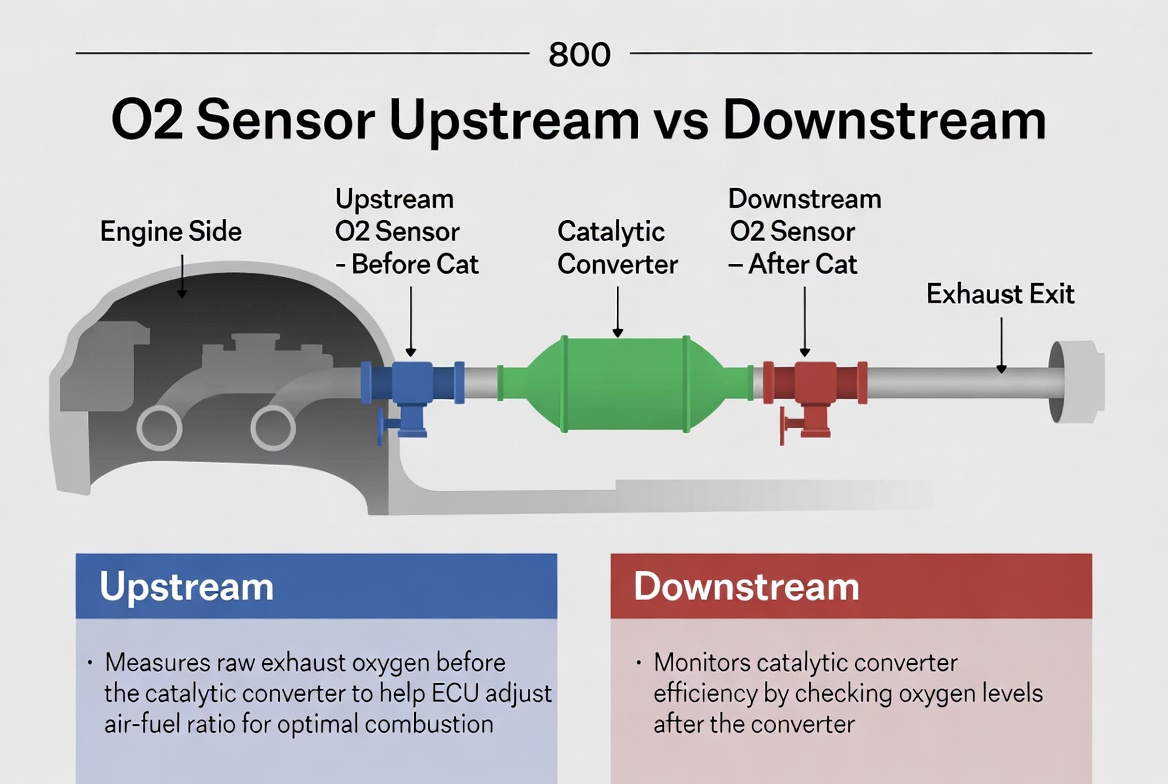
The upstream oxygen sensor sits before the catalytic converter. It’s close to the engine, right in the exhaust manifold or just after it.
You’ll also hear it called:
- Pre-cat sensor
- Pre-catalytic converter sensor
- Sensor 1
- Air-fuel ratio sensor (on some newer vehicles)
What Does the Upstream Sensor Do?
This sensor has the most important job. It reads the oxygen level in the exhaust gases right as they leave the engine. Then it sends that data to the ECM constantly — dozens of times per second.
The ECM uses this info to fine-tune the fuel injection. If there’s too much oxygen in the exhaust, the mixture is too lean (not enough fuel). If there’s too little oxygen, the mixture is too rich (too much fuel).
The upstream sensor keeps your engine running in a tight loop. This process is called closed-loop operation. It helps your engine stay efficient and keeps emissions low.
What Does the Upstream Sensor Signal Look Like?
On older vehicles, the upstream sensor produces a voltage signal that swings back and forth between about 0.1 volts and 0.9 volts. It switches fast — often more than once per second — as it tracks the fuel mixture in real time.
On newer vehicles, you might have a wideband air-fuel ratio sensor in the upstream position. These give a much more precise reading across a wide range instead of just switching high and low.
What Is a Downstream O2 Sensor?
The downstream oxygen sensor sits after the catalytic converter. It’s farther from the engine and closer to the back of the car.
You’ll also hear it called:
- Post-cat sensor
- Post-catalytic converter sensor
- Sensor 2
- Catalyst monitor sensor
What Does the Downstream Sensor Do?
This one has a different job. It doesn’t control the fuel mixture directly. Instead, it monitors the catalytic converter’s efficiency.
The catalytic converter burns off harmful gases like hydrocarbons, carbon monoxide, and nitrogen oxides before they leave the tailpipe. A healthy catalytic converter processes these gases well. That means the downstream sensor should see a stable, steady oxygen reading — not a wild swinging signal like the upstream sensor.
Your ECM compares the signal from the downstream sensor to the upstream sensor. If they look too similar — both swinging wildly — the ECM knows the catalytic converter isn’t doing its job. That triggers a P0420 or P0430 fault code and lights up your check engine light.
Upstream vs Downstream O2 Sensor: Side-by-Side Comparison
| Feature | Upstream Sensor | Downstream Sensor |
|---|---|---|
| Location | Before catalytic converter | After catalytic converter |
| Also called | Pre-cat, Sensor 1 | Post-cat, Sensor 2 |
| Main job | Controls fuel trim | Monitors catalytic converter |
| Signal behavior | Fast-switching | Slow and steady |
| Impact on fuel economy | High — directly controls fueling | Low — mainly a monitor |
| Common fault codes | P0131, P0132, P0134, P0171, P0172 | P0136, P0137, P0141, P0420, P0430 |
How Do They Work Together?
Think of it like a team. The upstream sensor is the quarterback — it’s calling the plays and adjusting in real time. The downstream sensor is more like a quality control inspector — it checks whether everything downstream is working right.
Together, they help your car:
- Burn fuel efficiently
- Keep emissions within legal limits
- Protect the catalytic converter from damage caused by a bad fuel mixture
- Alert you when something goes wrong
If just one of them fails, your car can still run — but it won’t run well. And if you ignore the issue, it can lead to bigger problems down the road.
Symptoms of a Bad Upstream O2 Sensor
Since the upstream sensor controls the air-fuel ratio, a bad one will usually cause noticeable driving issues. Here’s what to watch for:
1. Poor Fuel Economy
This is one of the first signs. When the ECM doesn’t get accurate oxygen readings, it can’t adjust the fuel injection properly. Your engine might run rich (burning too much fuel) and your gas mileage tanks.
2. Rough Idling or Misfires
A bad upstream sensor can cause the engine to run unevenly. You might feel a rough idle, stuttering, or even misfires when you accelerate.
3. Engine Hesitation
When you press the gas pedal, you might notice a delay or hesitation. The engine isn’t getting the right fuel mixture, so it can’t respond smoothly.
4. Failed Emissions Test
If your car runs too rich or too lean, it will pump out too many pollutants. That’s an automatic fail at the emissions testing station.
5. Check Engine Light with Specific Codes
Common fault codes tied to a failing upstream sensor include:
- P0131 — O2 Sensor Circuit Low Voltage (Bank 1, Sensor 1)
- P0132 — O2 Sensor Circuit High Voltage (Bank 1, Sensor 1)
- P0134 — O2 Sensor No Activity (Bank 1, Sensor 1)
- P0171 — System Too Lean (Bank 1)
- P0172 — System Too Rich (Bank 1)
Symptoms of a Bad Downstream O2 Sensor
A failing downstream sensor is a little sneakier. Since it doesn’t control fueling directly, you might not notice much in the way of driving symptoms at first. But that doesn’t mean you can ignore it.
1. Check Engine Light
This is usually the first thing you’ll notice. Your ECM detects that the downstream sensor signal is off and logs a fault code.
Common codes include:
- P0136 — O2 Sensor Circuit Malfunction (Bank 1, Sensor 2)
- P0137 — O2 Sensor Circuit Low Voltage (Bank 1, Sensor 2)
- P0141 — O2 Sensor Heater Circuit Malfunction (Bank 1, Sensor 2)
- P0420 — Catalyst System Efficiency Below Threshold (Bank 1)
- P0430 — Catalyst System Efficiency Below Threshold (Bank 2)
2. Catalytic Converter Gets Damaged Over Time
If the downstream sensor fails and the ECM can’t detect a bad catalytic converter, a failing converter can go unaddressed for too long. That can mean a very expensive repair later.
3. Failed Emissions Test
Just like with the upstream sensor, a faulty downstream sensor (especially one causing a P0420 code) will often mean a failed emissions test.
Can You Drive with a Bad O2 Sensor?
Technically, yes — your car will still run. But it’s not a good idea to drive for long with a bad O2 sensor.
Here’s why:
- A bad upstream sensor can cause the engine to run rich. That floods the catalytic converter with unburned fuel, which can overheat and destroy it. Catalytic converters cost a lot to replace.
- A bad downstream sensor might seem harmless at first, but it can let a failing catalytic converter go unnoticed until it fails completely.
The bottom line? Fix it sooner rather than later. It’s usually a straightforward repair, and putting it off can turn a cheap fix into an expensive one.
How to Test an O2 Sensor
You don’t need to be a mechanic to do a basic test. Here’s a simple way to check.
Use an OBD-II Scanner
Plug an OBD-II scanner into the diagnostic port under your dashboard. This port is usually near the steering wheel. The scanner will read fault codes and give you a starting point.
Some advanced scanners even show live sensor data. You can watch the upstream sensor signal switch back and forth in real time. A healthy upstream sensor should switch fast. A slow or stuck signal is a red flag.
Check the Wiring and Connector
Before replacing the sensor, take a look at the wiring harness. Burnt, frayed, or corroded wires can cause the same symptoms as a bad sensor. A damaged connector might be all that needs fixing.
Test Voltage with a Multimeter
If you’re comfortable with basic electrical testing, you can use a multimeter to check the sensor’s voltage output. A healthy upstream sensor should swing between roughly 0.1V and 0.9V. A downstream sensor should stay relatively steady.
How to Replace an O2 Sensor
Replacing an O2 sensor is one of the more beginner-friendly DIY car repairs. Here’s the general process:
- Find the sensor — Use your fault code to identify which sensor and bank need replacing (Sensor 1 = upstream, Sensor 2 = downstream; Bank 1 is the side with cylinder 1).
- Let the engine cool — Exhaust pipes get extremely hot. Always let the car cool before working on it.
- Use an O2 sensor socket — This special socket has a slot for the wiring harness. It makes removal much easier.
- Spray penetrating oil — Sensors can be seized in place from heat. A little penetrating oil and patience go a long way.
- Disconnect the connector — Unplug the electrical connector carefully before removing the sensor.
- Unscrew the old sensor — Turn counterclockwise to remove.
- Apply anti-seize compound — Put a thin layer on the threads of the new sensor (unless the new one comes pre-applied).
- Install the new sensor — Thread it in by hand first, then tighten with the socket.
- Reconnect the connector — Make sure it clicks into place.
- Clear the fault codes — Use your OBD-II scanner to reset the check engine light.
- Test drive — Take the car for a drive and check that the light stays off.
How Long Do O2 Sensors Last?
Oxygen sensors don’t last forever. On average:
- Older non-heated sensors: Around 30,000 to 50,000 miles
- Modern heated sensors (the ones most cars use today): Around 60,000 to 100,000 miles or more
That said, bad fuel quality, oil leaks, coolant leaks, or an excessively rich-running engine can shorten an O2 sensor’s life significantly.
How Much Does an O2 Sensor Replacement Cost?
The cost varies depending on your car and where you get the work done.
- The sensor itself: Usually between $20 and $100 for most vehicles. Some higher-end vehicles cost more.
- Labor: If you take it to a shop, labor can add $50 to $150 or more, depending on location and difficulty.
- DIY: If you do it yourself, you just pay for the part and maybe a cheap O2 sensor socket.
Upstream sensors can sometimes be harder to reach and cost a bit more in labor. Downstream sensors are usually easier to access.
OEM vs Aftermarket O2 Sensors
When buying a replacement, you’ll have two main choices.
OEM (Original Equipment Manufacturer) sensors are made by or for your car’s manufacturer. They fit perfectly and tend to work very reliably. They cost more, though.
Aftermarket sensors cost less and are made by third-party brands like Bosch, Denso, NGK, and Walker. A quality aftermarket sensor from a reputable brand works just as well as OEM in most cases.
One tip: avoid the cheapest no-name sensors you can find online. They often fail quickly or give inaccurate readings. Stick with brands known for quality.
Common Mistakes People Make with O2 Sensors
Replacing the Wrong Sensor
This happens a lot. You get a P0420 code and assume the downstream sensor is bad. But a P0420 code actually points to the catalytic converter, not the downstream sensor itself. The downstream sensor just detects the problem. Replacing the sensor without fixing the converter won’t solve the issue.
Always diagnose carefully before buying parts.
Ignoring the Root Cause
O2 sensors fail for a reason. Sometimes it’s just age. But sometimes it’s a symptom of a deeper problem — like an oil burning engine, a coolant leak into the exhaust, or a bad fuel injector running too rich. Replacing the sensor without fixing the root cause means the new sensor will fail too.
Not Resetting the ECM
After a replacement, always clear the fault codes with an OBD-II scanner. Also, remember that your car needs to complete a drive cycle — a series of driving conditions — before the ECM fully confirms the repair and clears the monitor. This matters especially if you have an upcoming emissions test.
Bank 1 vs Bank 2: What Does That Mean?
If you have a V6 or V8 engine, you’ll see references to Bank 1 and Bank 2 in your fault codes. Here’s how to tell them apart:
- Bank 1 is the side of the engine that contains cylinder number 1. Check your owner’s manual or a quick search for your specific vehicle to find out which side that is.
- Bank 2 is the opposite side.
So a code like P0141 (Bank 1, Sensor 2) means the downstream O2 sensor on the Bank 1 side has an issue.
For a 4-cylinder engine, there’s only one bank, so you’ll only see Bank 1 references.
Quick Recap: Upstream vs Downstream O2 Sensor
Here’s a fast summary to tie it all together:
- The upstream sensor lives before the catalytic converter. It actively controls the air-fuel mixture. It’s the more critical of the two for engine performance and fuel economy.
- The downstream sensor lives after the catalytic converter. It monitors the converter’s efficiency. It doesn’t control fueling, but it plays a key role in emissions monitoring and protecting expensive exhaust components.
- Both sensors send data to the ECM. Together, they help your car run cleanly and efficiently.
- A bad upstream sensor will usually cause noticeable performance issues. A bad downstream sensor might only show up as a check engine light — but ignoring it can get costly.
Final Thoughts
Oxygen sensors are small parts, but they do a big job. The upstream sensor keeps your fuel system in check. The downstream sensor watches over your catalytic converter. When either one fails, your car pays the price — in fuel efficiency, performance, or emissions.
The good news is that O2 sensor issues are usually easy to diagnose with a basic OBD-II scanner, and the repair is one of the more affordable fixes you can make. Catch it early, fix it right, and your car will thank you.
If your check engine light is on and you’re not sure where to start, grab a scanner, read the codes, and trace it back to the right sensor. You’ve got the knowledge now — use it.