
Your car’s audio system is like the heartbeat of your driving experience. When you’re stuck in traffic, cruising down the highway, or heading out on a road trip, quality sound can transform those moments from boring to absolutely epic. But here’s the thing—most people have no idea what their speakers are actually doing or how to pick the right size for better sound.
If you’ve ever opened your car door and wondered about those round things mounted in your doors, or if you’ve glanced at the dashboard and thought “what even is that speaker,” you’re in the right place. This guide breaks down everything you need to know about car speaker sizes without all the confusing technical jargon.
In this article
Why Speaker Size Really Matters
Think about the difference between a small clock radio and a full home stereo system. The size difference isn’t just about volume—it’s about how the speakers reproduce sound. Bigger speakers don’t always mean louder sound, but they do mean better sound quality and deeper bass performance.
Your car’s speaker dimensions affect several key things. The physical size determines how much air the speaker can move, which directly impacts the frequency range it can handle. Larger speakers tend to handle lower frequencies better, while smaller speakers work well for higher frequencies like vocals and treble notes. This is why car audio systems use different speaker sizes in different locations.
Car door speakers handle your mid-range and low sounds. Dashboard speakers up front manage your highs and vocals. Rear deck speakers add depth to your overall sound stage. Tweeter speakers produce those crisp high notes. Every position in your vehicle serves a specific purpose, and the speaker size plays a huge role in how well each position does its job.
When you’re upgrading or replacing your car stereo system, getting the speaker size right means the difference between enjoying your music and actually experiencing it. Wrong-sized speakers lead to gaps in sound quality, missing frequencies, and overall disappointment with your investment.
Common Car Speaker Sizes Explained
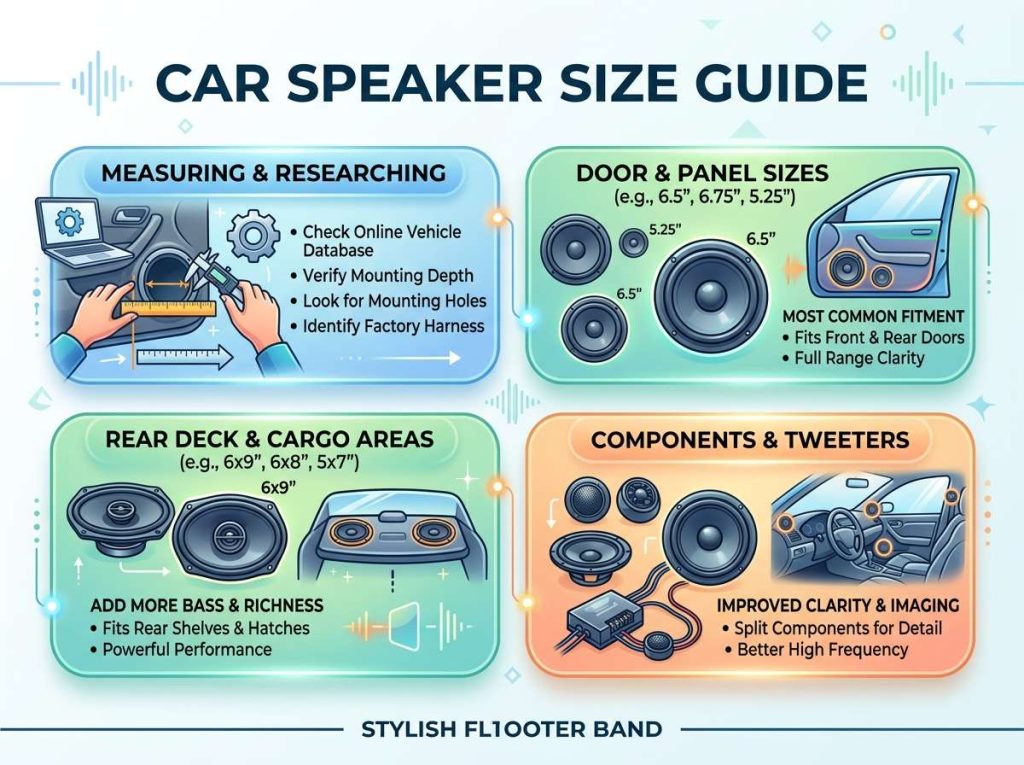
The most common aftermarket speaker sizes are 6.5 inches, 6×9 inches, and 5.25 inches. These dimensions refer to the diameter of the speaker cone—the part that actually vibrates to create sound waves.
6.5-Inch Speakers
This is the bread and butter of car audio upgrades. The 6.5-inch speaker is found in most factory car systems across a wide range of vehicles. You’ll typically find these in your car doors, front panels, or the rear package shelf.
A 6.5-inch component speaker system gives you solid mid-range reproduction and decent bass response. The 6.5 is versatile enough to handle both music genres well. Rock, pop, hip-hop, jazz—6.5-inch speakers work across the board. If you’re upgrading your car audio system and want to start somewhere affordable and effective, this is your sweet spot.
The cone area on a 6.5-inch speaker is about 33 square inches. That’s enough surface area to move a good amount of air and produce sound that fills your car without taking up excessive space. They’re easy to install in most vehicles because factory speaker locations were typically designed around this size.
6×9-Inch Speakers
Here’s where things get interesting. A 6×9-inch speaker is an oval design that covers more surface area than a round 6.5-inch speaker—about 43 square inches. This larger cone area means more air movement and stronger bass performance.
The 6×9 is perfect if you want that deeper, more powerful sound without completely overhauling your entire audio system. You’ll often find these mounted on rear deck areas or rear doors. They work great as coaxial speakers in stock setups and can be replaced with aftermarket 6×9 component speakers for even better sound.
The long, oval shape fits nicely in spaces where round speakers don’t work well. If your car has an unusual speaker opening or you’re dealing with a limited space situation, the 6×9 format gives you options. The drawback is that they’re less common than round speakers, so you have fewer options to choose from when upgrading.
5.25-Inch Speakers
The 5.25-inch speaker is smaller but mighty. This size works well in tight spaces where bigger speakers won’t fit. You’ll find these in compact cars, sedans, and sometimes as dashboard tweeters in higher-end systems.
A 5.25-inch speaker has roughly 21 square inches of cone area. That’s smaller than a 6.5, so it doesn’t move as much air, but that’s not always a bad thing. In the right location with proper installation, a quality 5.25-inch speaker produces clear, detailed sound. They’re particularly good for handling mid and high frequencies.
If you’re upgrading a compact car or you have tight speaker mounting locations, 5.25-inch options give you quality without needing tons of space. The trade-off is that they won’t give you as much bass kick as larger sizes.
4-Inch Speakers
Small but useful. The 4-inch speaker gets installed in tight locations like dashboards, side panels, or small shelf areas. These are typically your tweeter speakers or component midrange speakers in a multi-speaker setup.
A 4-inch speaker focuses on the higher frequency range. On its own, it won’t give you bass, but paired with larger speakers handling the lows, a quality 4-inch speaker adds brightness and clarity to your overall audio system. Think of it as adding sparkle to your music.
3.5-Inch and Smaller
When you go below 3.5 inches, you’re really talking about tweeter speakers or very specialized applications. A 3.5-inch tweeter produces those ultra-high frequencies that make vocals pop and add air to your music.
These tiny speakers are crucial in a complete component speaker system, but they work best as part of a bigger picture. You wouldn’t rely on a 3.5-inch speaker as your only audio source in your car, but as one component among many, it plays a vital role.
Understanding Coaxial vs Component Speaker Systems
Now that you know the common sizes, let’s talk about two different speaker configurations you’ll encounter when shopping.
A coaxial speaker system combines different parts into one unit. You get a woofer (the big part that handles lows and mids) and a tweeter (the small part that handles highs) stuck together on the same speaker. These are called 2-way coaxial speakers, or sometimes 3-way if they include a midrange driver too.
The advantage of coaxial speakers is simplicity. Everything is in one package, so installation is straightforward. The disadvantage is that the tweeter sits right next to the woofer, which can create weird sound positioning. Your high notes might sound like they’re coming from your car door instead of spreading evenly across your vehicle.
A component speaker system keeps parts separate. You install the woofer in one location, the tweeter in another. This separation gives you better sound staging—the audio feels like it’s coming from all around you instead of just from your doors. Component systems let you position each speaker for optimal sound delivery.
Component speakers cost more than coaxial speakers because you’re buying more pieces and getting better engineering. But the sound quality difference is noticeable, especially if you care about music quality and clarity.
Speaker Mounting Locations and Sizes
Different parts of your car work best with different speaker sizes. This isn’t random—it’s based on how sound travels in your vehicle and where you want to hear different frequencies.
Front Door Speakers
Your front car doors are prime real estate for audio. This is usually where people install their bigger drivers for powerful midrange and bass. A 6.5-inch speaker in the front door gives you strong mid and low frequency performance. This is where your music’s foundation lives.
Some cars have space for 6×9 speakers in their front doors if they have room. Others work best with 5.25-inch speakers. Check your vehicle’s specifications before buying, because forced installation destroys your car’s interior and doesn’t sound good anyway.
Dashboard Speakers
Dashboard locations are tight. You’re fitting speakers into spaces designed for factory systems that often weigh next to nothing. This is where smaller speakers shine—4-inch and 3.5-inch sizes work great here.
Many aftermarket dashboard speaker solutions use 5.25-inch sizes when space allows. The key is that dashboard speakers handle high frequencies and vocals, so you don’t need massive drivers here. Quality matters more than size.
Rear Speakers
Rear door or rear deck speakers add depth to your sound. These often get 6.5-inch or 6×9-inch speakers. Some systems use 5.25-inch rear speakers as fill-ins, providing ambient sound rather than main audio.
Think of rear speakers as supporting actors. They’re not carrying the main load like front speakers, but they matter for the overall experience. A common setup pairs larger front speakers with slightly smaller rear options.
Subwoofer Considerations
While not technically a speaker size guide, subwoofers deserve mention because they change how you think about speaker sizing. A subwoofer handles bass frequencies below what regular speakers can manage efficiently.
If you’re adding a subwoofer to your system, you can use slightly smaller midrange and tweeter speakers up front because the sub handles the heavy bass lifting. This is why many aftermarket systems pair 5.25-inch component speakers with a powerful subwoofer and get better results than someone running larger 6.5-inch speakers without a sub.
How to Measure Your Car Speakers
Before you buy replacement or upgraded speakers, you need to know what size spaces you’re working with. Measuring sounds harder than it actually is.
Pop off your speaker grille or cover. Look at the speaker opening. You need to measure the diameter of the circular opening (for round speakers) or the length and width (for oval speakers like 6×9).
For round speakers, measure from one edge of the mounting hole to the opposite edge straight through the center. Round to the nearest quarter inch. If you measure 6.2 inches, that’s a 6.25-inch speaker space, commonly sold as 6.5 inches (manufacturers round differently).
For oval speakers, measure the long dimension and the short dimension the same way. A 6×9 opening will measure roughly 6 inches in one direction and 9 inches in the other.
Don’t measure the speaker cone itself. Some speakers have cones that stick out beyond the mounting ring. Measure the mounting ring diameter or the speaker opening size. That’s what determines if a replacement speaker will fit.
Check your car’s documentation if you have it. Many owner’s manuals include speaker size information. Online forums for your specific vehicle model often have members who’ve already mapped out all the speaker locations and sizes. That’s a huge time saver.
Upgrading From Factory Speakers
Most factory car speakers are… well, let’s say they’re not optimized for music lovers. Car manufacturers prioritize cost and packaging over audio quality. A factory 6.5-inch speaker might be pretty basic compared to an aftermarket option.
Upgrading to aftermarket speakers in the same size category instantly improves your sound. An aftermarket 6.5-inch speaker with quality components, better engineering, and real tweeters beats a factory 6.5-inch speaker every single time.
You don’t need to size up to get better sound. A quality aftermarket 5.25-inch speaker system will outperform a cheap factory 6.5-inch speaker. Materials matter. Driver design matters. Tweeter quality matters. Size is just one piece of the puzzle.
That said, if you’re upgrading from 5.25-inch factory speakers to 6.5-inch aftermarket speakers, you’ve got two improvements working for you—better quality and bigger size. That’s a recipe for noticeably better sound.
Matching Speakers to Your Vehicle Type
Different vehicles have different audio needs and different speaker mounting situations.
Compact Cars and Sedans
Compact cars often have tight spaces. You’ll typically work with 5.25-inch or 6.5-inch door speakers. Dashboard locations are cramped, so 4-inch speakers often work best. If you love bass, a small powered subwoofer hidden under a seat makes a huge difference without taking up trunk space.
Trucks and SUVs
Trucks have bigger cabins and more space, which means you can go bigger with your speakers. 6.5-inch and 6×9-inch options work great. Rear seats or cargo areas often have room for larger subwoofers if you want serious bass performance.
Trucks also benefit from component speaker systems because the larger cabin lets you properly position tweeters and woofers for good sound staging. A properly installed 6.5-inch component system in a truck sounds amazing.
Convertibles and Sports Cars
These vehicles benefit from powerful speakers because they compete with wind noise when the top is down. Larger speakers and a powered subwoofer make sense. Sports cars often have factory audio locations designed to work with specific sizes, so research what fits before buying.
Installation Tips and Tricks
Knowing the right size is half the battle. Installing correctly is the other half.
Before installation, gather the right tools—a screwdriver set, a socket set if you’re removing trim pieces, speaker mounting brackets if they’re not included, and wiring supplies. Some cars need special trim removal tools—check your vehicle manual or online forums.
Disconnect your car’s battery before doing any electrical work. This is basic safety stuff. Failing to do this can damage your car’s electronics or cause injury.
If your new speakers don’t sit flush in the existing mounting locations, you need mounting brackets. These metal or plastic adapters let you install aftermarket speakers in factory locations. They’re cheap and essential.
Running new speaker wires means routing them carefully so they don’t get pinched by door mechanisms or damaged by sharp metal edges. Leave slack at the speaker end so doors can open and close smoothly. Some people wrap wires in plastic tubing for extra protection.
Make sure your head unit has enough power to drive your new speakers. Factory head units are sometimes wimpy. If you’re installing high-quality aftermarket speakers, adding an amplifier makes a big difference.
Test your speakers at low volume first to make sure everything’s connected correctly. Then gradually increase volume while listening for any rattles or distortion. Rattles usually mean something’s not mounted tightly.
Sound Quality Factors Beyond Size
Speaker size matters, but it’s far from the only thing determining your audio quality.
The speaker material affects sound. Paper cones have a warm, natural tone. Polypropylene is durable and handles moisture better. Woven fiber materials handle detail well. Different materials suit different music genres and listening preferences.
Voice coil size and quality affect how cleanly the speaker can reproduce sound. A larger voice coil means better power handling and more accurate sound reproduction. Quality coil windings and wiring mean less distortion.
The speaker’s surround (the flexible ring holding the cone) affects how the cone can move. Rubber surrounds last longer and handle moisture better than foam, especially in cars where humidity is an issue.
The magnet strength determines how powerfully the speaker responds to electrical signals. A stronger magnet means faster response and cleaner sound, especially at higher volumes.
Speaker sensitivity (measured in decibels) tells you how loud a speaker gets with a given amount of power. A more sensitive speaker needs less power to play loud. This matters if you have a weak factory head unit.
Frequency response range tells you what frequencies the speaker can reproduce. A speaker that handles 20Hz to 20kHz reproduces the full human hearing range. Cheaper speakers might only handle 50Hz to 16kHz, missing some very low and very high frequencies.
Matching Your System Components
When you’re building a car audio system, different pieces need to work together.
A car audio amplifier needs speakers it can properly power. Undersizing your speakers to big amplifiers wastes potential and risks speaker damage. Oversizing your speakers to wimpy amplifiers means you never hear what they’re capable of.
Your head unit (car stereo receiver) needs to be powerful enough to drive your speakers or you need amplification. Modern high-quality head units output between 18-50 watts per channel. That’s enough for decent speakers without adding an amp. If you want seriously loud or really accurate sound, an amp helps.
A powered subwoofer is self-contained—it has its own amp built in. You just connect it to your head unit. A passive subwoofer needs an external amplifier, adding complexity and cost.
Crossovers direct appropriate frequencies to appropriate speakers. A high-pass crossover sends high frequencies to your tweeters, protecting them from low frequencies they can’t handle. A low-pass crossover sends low frequencies to subwoofers, protecting door speakers from bass they don’t need to handle.
Real-World Speaker Size Recommendations
Let’s cut through the confusion with actual recommendations for common situations.
If you’re upgrading a basic sedan with factory speakers and a budget under $500, get a good quality 6.5-inch component speaker system for the front doors and 5.25-inch or 6.5-inch rear speakers. This gives you dramatic sound quality improvement.
If you love bass and want deeper sound, add a powered 8-inch or 10-inch subwoofer. Your whole system improves because your door speakers can focus on midrange instead of trying to produce bass too.
If you drive a truck and want powerful, room-filling sound, go with 6.5-inch or 6×9-inch component systems in the front doors, add quality 6.5-inch speakers in the rear, and throw in a powered subwoofer. This setup dominates in trucks.
If you have a compact car with limited space, stack quality 5.25-inch speakers everywhere they fit, add a 4-inch component tweeter system for detail, and include a powered subwoofer for bass. Smaller speakers with better engineering beat cheap big speakers every time.
If you’re going all-in and want the absolute best sound from your car, plan your system around a quality amplifier. Run separate amps for different speaker groups. Use component systems everywhere. Include a dedicated subwoofer. Install quality cables and a proper power distribution block. This gets expensive fast, but the sound is incredible.
Common Mistakes People Make
Learning from others’ mistakes saves time and money.
The biggest mistake is buying bigger without checking if it fits. A 6×9 speaker won’t fit in a 6.5 hole no matter how hard you push. Measure twice, buy once.
Another mistake is pairing professional-quality speakers with a terrible head unit. Your music source matters. A $200 component speaker system sounds mediocre if your head unit is a $50 unit from the trunk sale at a car meet.
People often install speakers without proper sound deadening material. Adding dampening foam or spray to your door panels dramatically improves bass response and clarity. Bare metal doors vibrate and distort sound. Damped doors keep sound clean.
Skipping an amplifier is a mistake if you’re serious about sound. Many people think a good head unit is enough. It’s not. An amp lets your speakers perform and protects them from clipping distortion.
Not using proper mounting hardware is dangerous and sounds bad. Speakers need to be securely mounted. Loose speakers vibrate against mounting holes, creating rattles and distortion.
Diagnosing Speaker Problems
If your sound quality is bad, it might not be the speaker size—it might be the speaker condition.
Listen carefully. Does the problem happen at low volumes or just when you crank it up? Bad surround material often creates distortion at volume. Do you hear rattling? Something isn’t mounted tightly. Does one channel sound quieter than the other? Check your connections and wiring.
Try playing different music. Sometimes problems are really obvious with certain frequencies. A song full of bass might reveal subwoofer problems. Vocal-heavy music reveals tweeter issues.
Remove the speaker grille and listen directly to the speaker. This isolates the speaker from other system components. If it sounds better without the grille, the problem might be the mounting or the rest of your system.
Check your connections. Make sure positive and negative wires are properly connected to the right terminals. A reversed connection between speakers causes cancellation that kills bass.
When Size Actually Isn’t the Answer
Sometimes people think they need bigger speakers when they really need something else.
If your bass is weak, a bigger door speaker won’t help much. You need a subwoofer. Door speakers aren’t designed to handle bass frequencies efficiently.
If your sound is dull, you probably don’t have a decent tweeter. Bigger woofers don’t make sound brighter. Better tweeters and proper crossovers do.
If one channel is quieter, check your wiring and connections before blaming the speaker. A loose wire causes way more problems than a bad speaker.
If everything sounds distorted, your head unit or amplifier might be clipping. More power or better equipment solves this, not bigger speakers.
Final Thoughts on Car Speaker Sizing
Your car’s audio system is a journey, not a destination. Most people don’t get everything right the first time, and that’s fine. You learn as you go.
Start by understanding what sizes your car currently has. This gives you a baseline. Then decide what you want to improve. Better overall sound quality? Deeper bass? More clarity? Your goals determine what changes make sense.
Don’t get caught up in size comparisons. A great 5.25-inch system beats a mediocre 6.5-inch system every single time. Quality matters more than pure dimensions. Quality components, proper installation, and thoughtful system design produce amazing sound.
Do your research specific to your vehicle. Every car is different. What works in someone’s sedan might not fit in your truck. Online forums and owner groups are goldmines of information about what fits, what sounds good, and what problems others encountered.
Budget matters, but buy quality over quantity. A single great component does more for your system than several cheap pieces. Start with front speakers, add a subwoofer next, then upgrade rear speakers, then add an amp. Building gradually lets you hear improvements and learn.
The best car audio system is the one that makes you happy listening to music you love. Numbers and specifications matter, but your ears matter more. If it sounds good to you, it’s good.
Now get out there and upgrade that audio system. Your commute is about to get so much better.
